Connected Mathematics®4: Field Test Results Overview
The Connected Mathematics Project (CMP) at Michigan State University (MSU) has been working for over 40 years to design, develop, field-test, evaluate, and disseminate mathematics materials for middle school students and teachers.
Evolution of CMP Over 40 Years
Connected Mathematics®4 (CMP4) – Co-Development with Teachers and Students
|
The unique development process spanned multiple years of design, field-testing, and feedback cycles. Yearly feedback from teachers, administrators, researchers, parents, and students directly shaped the materials. 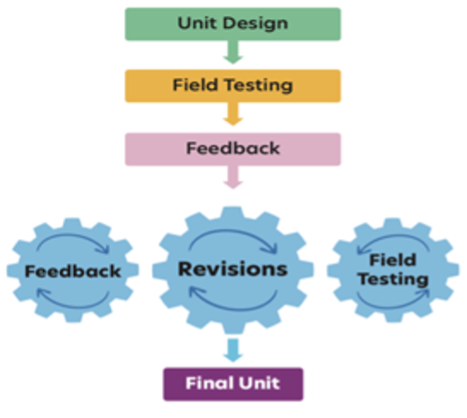 |
 |
CMP4 was field-tested with more than 500 teachers from 25 states and six international territories. These interactions between teachers and students with the materials were among the most compelling aspects of the development process.
|
Adapted from: Edson, A.J., Wald, S., & Phillips, E. D. (2025). The design, field-testing, and evaluation of a contextual, problem-based curriculum: Feedback analysis from mathematics teachers on the fourth edition of CMP. Education Sciences, 15(5), 628, 1–29. https://doi.org/10.3390/educsci15050628
Built on Research Findings from CMP1, CMP2, and CMP3
|
CMP is one of the most researched mathematics curriculum programs in the history of mathematics education. CMP4 builds on the research, experience, and successes of prior editions while designing innovative new elements to address societal needs and support students and teachers. For more on CMP research, see Highlights of CMP Research . |
|
CMP4 Field Test Results
|
Results from a 2023 survey of 233 CMP4 field-test teachers, coaches, and administrators across 70 cities and 20 U.S. states, as well as three additional countries, showed the following. |
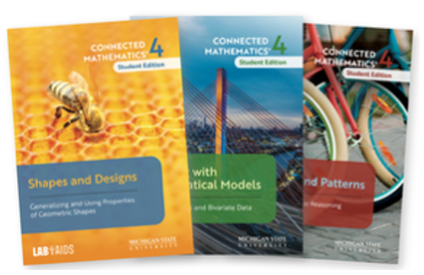
CMP4 Unit Examples |
CMP4 Problems Promote Student Engagement and Learning in Mathematics
- Increased Student Engagement and Collaboration: Over 95% of teachers reported that their students were equally or more engaged in mathematics and critical thinking with CMP4. Teachers also valued the emphasis on student collaboration, which they found to enhance engagement and problem-solving skills.
- Effectiveness of the New STEM Problem Format: Approximately 90% of teachers rated the CMP4 STEM Problem Format as effective in promoting student engagement and learning, noting its role in developing critical thinking and extending students’ problem-solving abilities.
- Teacher Feature Awareness: Around 15–22% of teachers were unaware of key curriculum features, such as the Individual Learning Needs Framework and overview videos, which could better support diverse learners in the classroom.
CMP4 Problems Support Students in Solving Problems, Making Mathematical Connections to Real-Life Applications of Mathematics, and Sharing Multiple Solution Strategies
- Problem Solving and Mathematical Discourse: CMP4 Problems embed mathematics within contextualized, story-based problems, promoting active student engagement and critical thinking. Over 50% of teachers reported that students’ communication with mathematical language was more effective than the previous year.
- Real-World Connections to Mathematics: CMP4 Problems help students connect mathematical concepts to real-life applications, allowing them to see the relevance of math in everyday situations. Teachers noted that this approach fosters a deeper understanding of both mathematical content and its real-world significance.
- Building Mathematical Connections Across Units: CMP4 enables students to make connections between math concepts from different units, reinforcing prior knowledge and building toward future content. Teachers appreciated the curriculum’s cyclical approach, which promotes critical thinking, multiple strategies, and ongoing concept reinforcement.
| Testimonials from the Field Test Teachers | |
|---|---|
| “Teaching CMP4 is riveting! Never have I ever seen students so engrossed in mathematics!
They are explorers, detectives, scientists, mathematicians, and inventors! They enter
the classroom with so much enthusiasm it’s almost as if they don’t even realize they
are learning!” Heather Gust, Timberstone Junior High, Sylvania, Ohio |
“The CMP STEM Problem format is refreshing, intuitive, and self-differentiating. Students
begin by engaging with new concepts at an entry level and each can go as deep into
the problem as is appropriate for their individual levels of understanding.” Chris Driscoll, Falmouth Middle School, Maine |
| “Engagement in my classroom with CMP4 is very high! I have yet to see a student disinterested
in a problem or unmotivated to solve it. The contexts are real, interesting, and challenging.
Every child, regardless of ability, has an entry point! Also, the What If? has additional
practice for any level and allows me to reach all learners.” Melanie Del Grosso, Junior High Math Teacher St. John Bosco Catholic School, Arizona |
“Starting off the sixth-grade year with an algebra unit provides students many authentic
opportunities to apply and deepen their algebraic understanding all year long. Using
the CMP4 materials has increased my students’ confidence and empowered them to be
more algebraic in their mathematical thinking and communication.” Jenny Douglas, Forest Hills Public Schools, Michigan |